From Uncertainty to a Packed Session: What the 2026 spring CUE conference (powered by calie) Confirmed About AI and Writing
By: Amelia - Teacher, Campus AI Coach, and Co-Founder
Last year, I attended CUE for the first time.
I walked into sessions, listened, took notes, and tried to figure out where we fit in a rapidly changing conversation around AI in education. Like many educators, I was asking the same questions: Where is this going? What actually works? And what does this mean for teaching and learning in real classrooms?
This year was different.
This year, we weren’t just attending. We were presenting.
Our session, The AI Writing Revolution: Using AI to Foster Authentic Thinking and Powerful Writing, was scheduled in the final time slot on the last day of the conference. If you’ve ever been to a multi-day conference, you know what that usually means. People are heading home. Energy is low. Rooms are often half full.
We didn’t know what to expect.
More than 50 educators showed up.
And more importantly, they stayed engaged, asked questions, and leaned into the conversation.
What We Shared—and Why It Resonated
At the center of our session was a simple but urgent idea:
We are not just teaching students to write. We are teaching them to think in a world where writing can be automated.
That shift changes everything.
Instead of framing AI as something to ban or control, we focused on how to use it intentionally as an instructional tool:
Process, not product
Support, not substitution
Instruction, not enforcement
Teachers lead the learning
From there, we walked educators through practical strategies they could use immediately in their classrooms:
1. AI for Pre-Writing (Without Replacing Thinking)
Students use AI to generate possibilities, not answers. They engage with ideas, clarify their thinking, and make decisions before writing begins.
2. AI as a Revision Partner (Not a Replacement)
AI provides targeted feedback, but students remain the decision-makers. The thinking happens in response to AI, not in place of it.
3. Redirecting Cognitive Load
We let AI handle lower-level tasks like formatting so students can focus on reasoning, evidence, and argumentation.
Throughout the session, we emphasized something we believe deeply: structure matters. The difference between AI that replaces thinking and AI that develops thinking is how it is used.
The Equity Conversation We Can’t Ignore
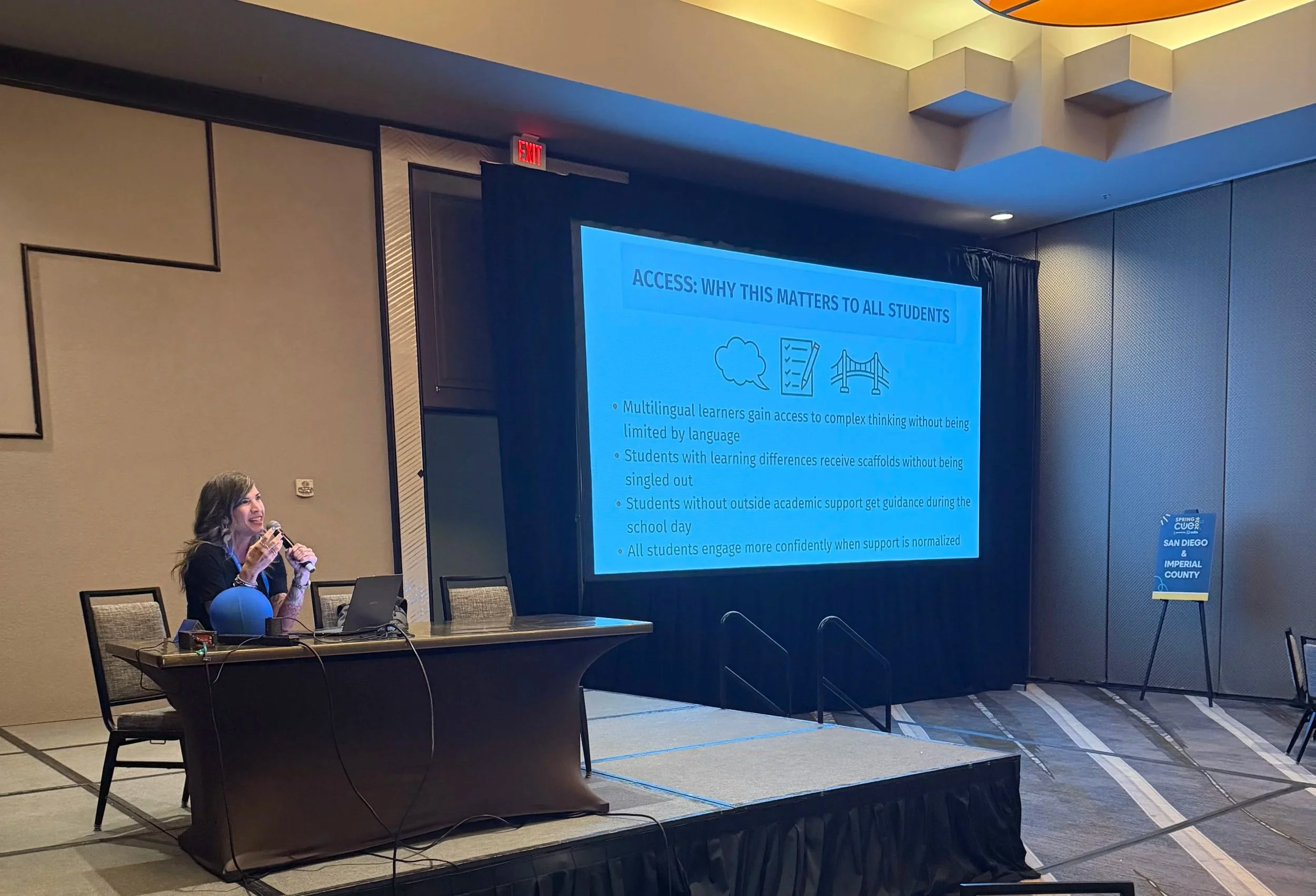
One of the most important parts of the session—and one that generated the most discussion—was access.
When used intentionally, AI can:
Give multilingual learners access to complex thinking without being limited by language
Provide scaffolds for students with learning differences without singling them out
Offer real-time support to students who don’t have help outside of school
Normalize support so all students can engage more confidently
This is not just about innovation. It is about opportunity.
What Educators Told Us
The feedback we received reinforced something we’ve been seeing in our own work:
“You had so many practical applications for AI that I can use tomorrow.”
“It encouraged me to reframe my thinking around AI and how to learn to use it effectively.”
“I would love more info to make sure that there is consistency and equity with AI use in the classroom.”
Educators are not looking for theory alone. They are looking for clarity, structure, and practical ways to move forward.
What CUE Confirmed for Us
Walking away from this experience, one thing is clear:
This work matters.
Not because AI is new or exciting, but because teachers are trying to navigate it without enough support. There is a real need for models that are both practical and grounded in instruction.
That is where we see our role.
We are not trying to replace teachers with technology. We are working to support teachers in using AI in ways that strengthen thinking, deepen learning, and expand access for all students.
And if this session was any indication, this is a conversation that educators are ready to have.
Final Thought
Don’t ban the technology.
Teach the thinker.
