What we’re carrying into the new school year
By: David - Principal, Researcher, and Co-Founder

This summer gave me an opportunity to do something I always value: share what we are learning while also learning from educators across the country.
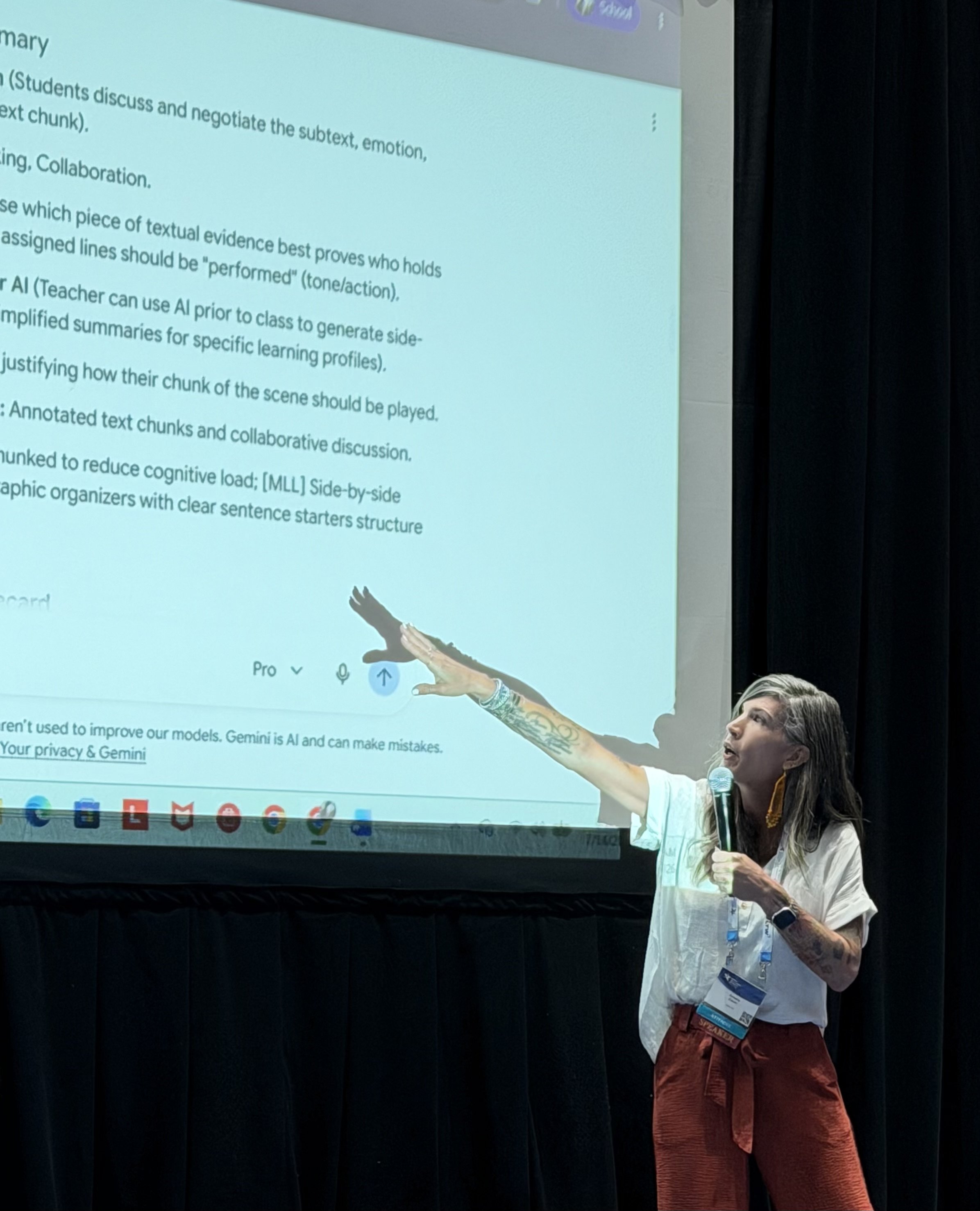
Amelia and I presented at both the National Association of Elementary School Principals’ National School Leaders Conference and the Innovative Schools Summit. Our presentations focused on artificial intelligence, the Four Pillars, and how schools can create learning experiences that better prepare students for the world they are entering.
At NAESP, we presented Aligning Instruction with Purpose: The Four Pillars Framework Supported by AI, emphasizing that collaboration, problem solving, critical thinking, and communication cannot be treated as extras. They have to be intentionally built into daily instruction. At the Innovative Schools Summit, we expanded that conversation through sessions on AI coaching and engaging instruction for English learners. One of the most meaningful messages from those presentations was simple: the standards do not have to change for the student experience to change.
The presentations were successful, but one of the best parts of the summer had little to do with standing in front of a room. It was meeting educators from across the country, listening to their experiences, exchanging ideas, and building relationships with people who are wrestling with many of the same questions we are. Those conversations reinforced for me that schools everywhere are trying to determine how AI fits into teaching and learning.
The more I learn about AI, the more convinced I become that the Four Pillars are even more important.
AI will continue to change the tools students use, but collaboration, problem solving, critical thinking, and communication remain essential human skills. With or without AI, students need repeated opportunities to practice them. Our presentations emphasized that strong Four Pillars classrooms are characterized by high engagement, intentional discussion, structured collaboration, deeper comprehension, and a focus on process over product.
AI can strengthen that work. It can help teachers create scaffolds, discussion prompts, multiple pathways into challenging content, and opportunities for students to analyze, question, revise, and communicate. But AI should support learning rather than replace the thinking students need to do. As we shared this summer, teachers remain the decision-makers, while AI can serve as a planning partner that generates options, scaffolds, and variations.
That is also why students learning how to use AI appropriately is so important. Avoiding AI does not prepare students for their future. Teaching them to use it thoughtfully, critically, ethically, and productively does.
As we begin another school year, I will continue inviting our faculty to explore AI and intentionally incorporate the Four Pillars into instruction. We are already seeing the impact: more classroom engagement, more interaction, stronger collaboration, more student speaking, and more opportunities for authentic problem solving. Our work with
AI coaching has also produced richer student conversations about learning and greater teacher confidence in experimentation and risk-taking.
Perhaps most importantly, the role of the teacher is evolving. While educators have long talked about teachers as facilitators of learning, AI is accelerating the shift from teacher-centered classrooms toward learning experiences where students have a more active role. Students are being asked to experience learning, to discuss, challenge, create, solve, defend, revise, and reflect, rather than simply receive information and reproduce it on a test.
That may be my biggest takeaway from this summer.
Technology will continue to change. The tools will continue to improve. But the skills our students need remain remarkably consistent.
The Four Pillars give us the framework. AI gives us new ways to support it. And when we intentionally design for both, the result is a richer, more meaningful learning experience for every student.
By: Amelia - Teacher, Campus AI Coach, and Co-Founder
David mentioned some of the conferences we attended this summer, and for me, they were part of one of the best summers I've ever had.
I traveled. Nothing huge, I didn't leave the country, but in the past, "traveling" in the summer meant I made a day trip to the beach about two hours away. While I did make it to the ocean a few times - a non-negotiable for me - I also traveled outside of California multiple times. I attended several conferences, both as a speaker and as an attendee. I experienced a lot, learned so much, and created lasting memories. I defended my Ph.D. research proposal. It was accepted.
And, in the midst of all that, I started thinking about my English II curriculum.
I considered how effective it has been when I am intentional about incorporating the Four Pillars into my students' learning experiences. I read over my research notes. I thought about the literature we read in class. I made lists of what was working, what was missing, and what needed to change.
Mostly, I thought about what I want my students to know when they leave my class in June.
I don't mean the standards and benchmarks - those are a given. I mean what they figured out about their own learning. What can change when students actually see what and how much they learn over time?
And I started wondering what would happen if I redesigned my entire curriculum around the Four Pillars and the intentional use of AI.
Could the Four Pillars keep students from handing their thinking over to AI? Could AI, used intentionally, give students even more opportunities to collaborate, solve problems, think critically, and communicate?
So I redesigned everything. It was a complete overhaul. Every learning experience, every task, every assessment, the goals, the format. Everything.
AI will be present throughout the year, but it won't always be used. My students will do their own thinking before AI enters the process. When they do use it, they will analyze and evaluate its output. Sometimes they'll use what it gives them to make their work stronger. Sometimes they'll recognize that it has flattened their voice or taken their thinking somewhere they don't want it to go. And sometimes, I hope, they'll decide they don't need it at all.
I want them to learn that deciding whether to use AI matters as much as knowing how to use it.
At the same time, they'll have more agency over their learning. They'll set goals and reflect on their progress. They'll collaborate, solve problems, think critically, and communicate every time they step into my room.
The artifacts they choose will become part of a year-long portfolio. At the end of second semester, with a year of growth behind them, their final will involve communicating to their peers how much they've learned.
And they'll have the evidence to prove it.
There is a lot more to it, and I'm anxious to get started. In some ways, it will feel like my first year all over again.
I know what I've designed. I know why I've designed it.
What I don't know yet is what my students will do with it.
By June, I hope they can look back at a year's worth of work and see something that can be difficult for a tenth grader to recognize while it's happening: just how much they've grown.
And this week, we get to start.
