How students learn with ai
By: Amelia - Teacher, Campus AI Coach, and Co-Founder
I'm heading into the third week of summer break, which means I've reached a transition point that I experience each year.
I usually spend the first couple of weeks recovering.
I sleep a little later. My mornings are slower. I read books that have nothing to do with education. I stop measuring my days in 50-minute periods. The pace quiets down enough for me to remember what it feels like to think about something simply because I'm curious about it.
Then something shifts and the ideas start showing up again.
A thought becomes a page of notes. A conversation I had months ago connects to something I'm working on now. I find myself thinking through ideas, revisiting old questions, and getting excited about the year ahead.
That's where I am right now.
And this summer, one realization keeps finding its way back to me.
Over the past year, I've spent a lot of time in conversations about artificial intelligence.
I've worked with teachers who were excited to try it. I've worked with teachers who were hesitant. I've sat with administrators trying to make sense of what AI means for schools. I've listened to students describe the ways they use it, the ways they misuse it, and the ways they wish adults understood it better.
For a while, it felt like every conversation started in the same place.
What tool are you using?
What platform do you recommend?
How should we handle cheating?
What prompt works best?
Those questions make sense. AI arrived quickly, and educators are trying to get their footing.
But if I'm being honest, I'm not seeing enough of the conversations that matter most.
At conferences, in articles, on social media, and in professional learning sessions, we are still spending an incredible amount of time talking about tools.
Which tool. Which platform. Which feature. Which policy. Which detector.
I understand why.
The technology is changing faster than schools typically move.
But lately I've found myself growing restless, because while we're debating the tools, students are already using them.
While we're discussing what AI might become, students are figuring out what it already is.
And I keep coming back to the same question: What are students supposed to learn now?
Not what they should know about AI, not what rules should govern AI, but how to learn with AI present in the world.
That feels like the conversation we're not having nearly enough.
For years, we have treated access to information as a meaningful advantage. Students spent countless hours gathering facts, locating sources, and finding answers.
Now information arrives almost instantly. Whether we welcome that reality or resist it, the question remains.
What do we want students to do with what they know?
That question has followed me throughout the past year. Into classrooms, into coaching conversations, into conference sessions.
Into lengthy discussions that continued long after the scheduled end time.
And every time I come back to it, I find myself returning to the same things.
Students discussing ideas that don't have easy answers.
Groups working through a problem together.
Writers learning to clarify their thinking.
Learners defending a position, revising it, and sometimes changing their minds.
Moments when students are doing the intellectual work that no technology can do for them.
Those moments mattered before AI.
They matter even more now.
The more I think about this, the more I realize I can't wait for someone else to answer the question.
I can't wait for a textbook company.
I can't wait for a curriculum publisher.
I can't wait for a state framework.
The students who walk into my classroom this August won't have that luxury, and neither will I.
So this summer I've found myself thinking less about technology and more about learning experiences.
The questions we ask.
The conversations we facilitate.
The challenges we place in front of students.
The opportunities we create for them to communicate, collaborate, think critically, and solve meaningful problems.
Those are the things that stay with students long after a platform changes or a new tool arrives.
Don’t get me wrong. I still strongly believe that AI belongs in our classrooms. In many ways, that’s exactly why I’ve been wrestling with these questions.
The goal isn’t to find ways to add AI to learning. The goal is to create learning experiences that become better because AI is part of them.
That’s an entirely different conversation.
If I’m waiting for someone to hand me a curriculum that intentionally develops collaboration, problem solving, critical thinking, and communication while helping students learn alongside AI, I may be waiting for a very long time.
Maybe that's why I've been unable to shake this feeling that we're still circling around the wrong question.
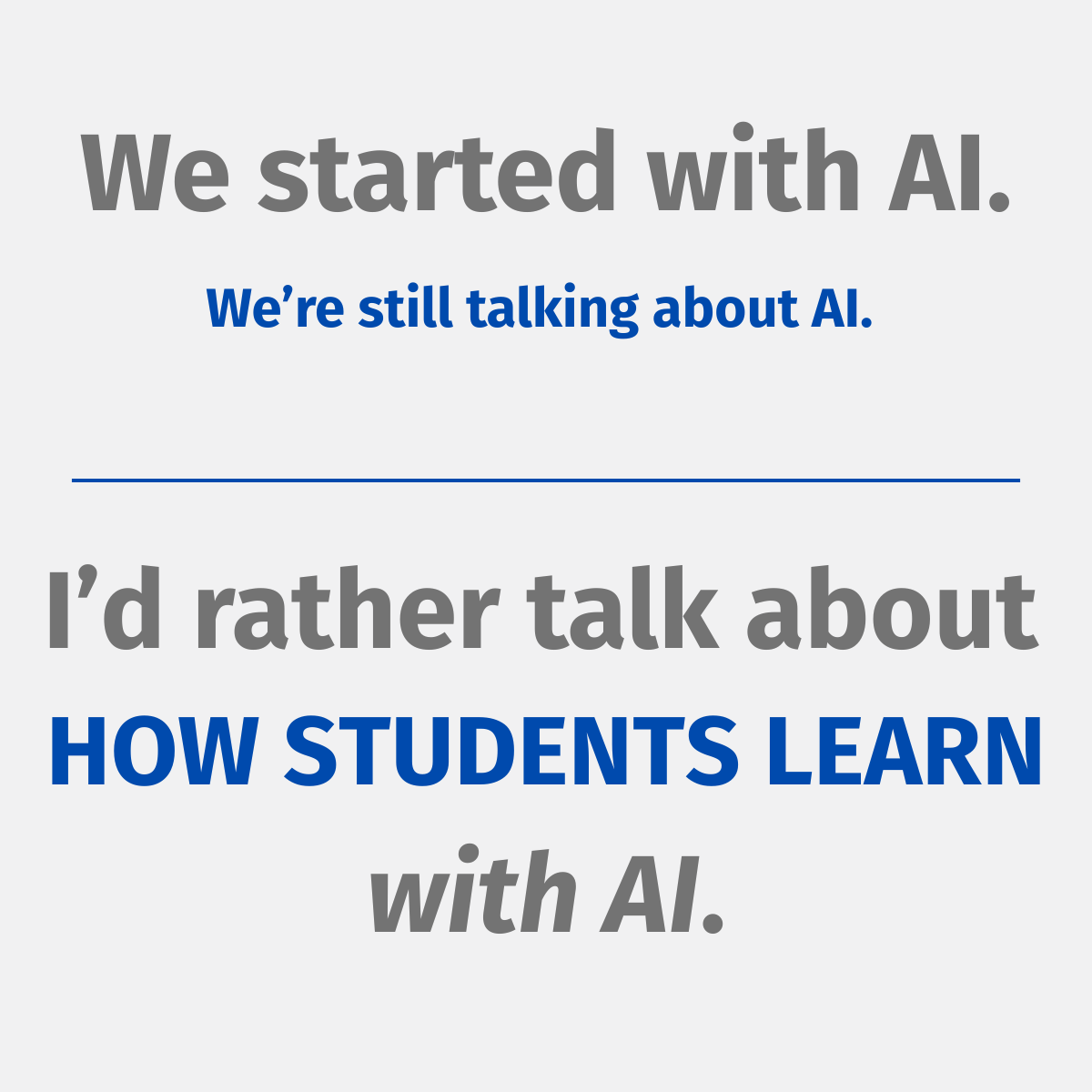
We started with AI.
Years later, we're still talking about AI.
I'd rather talk about how AI can help us create better learning experiences for students.
